
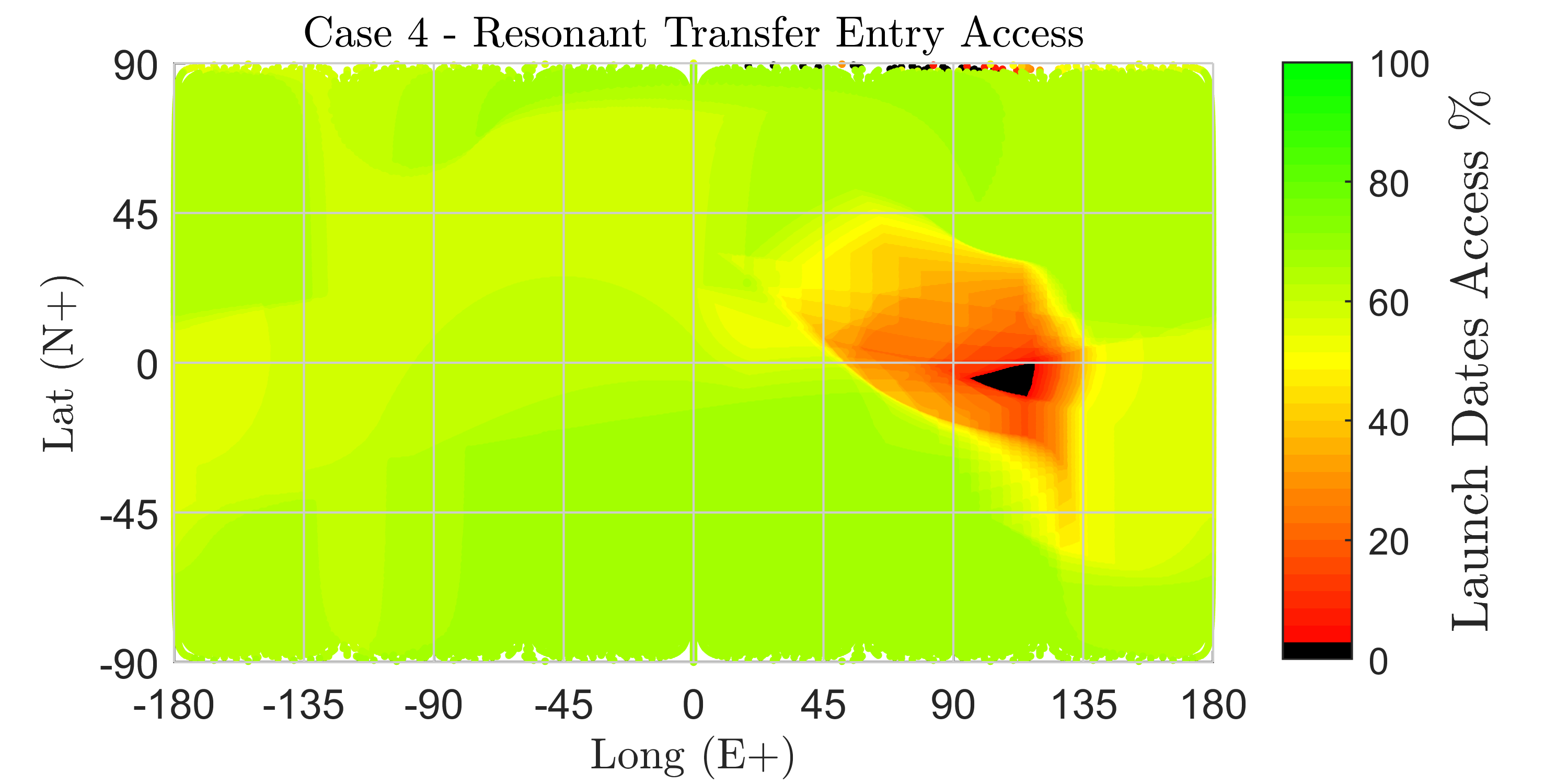
This project studies whether a Venus gravity assist followed by a resonant heliocentric transfer can expand the accessible entry footprint for Venus probes and landers. The problem is geometric: a direct Earth-to-Venus arrival gives a mission only a limited set of entry geometries, and those geometries must also satisfy entry corridor, lighting, and communication constraints.
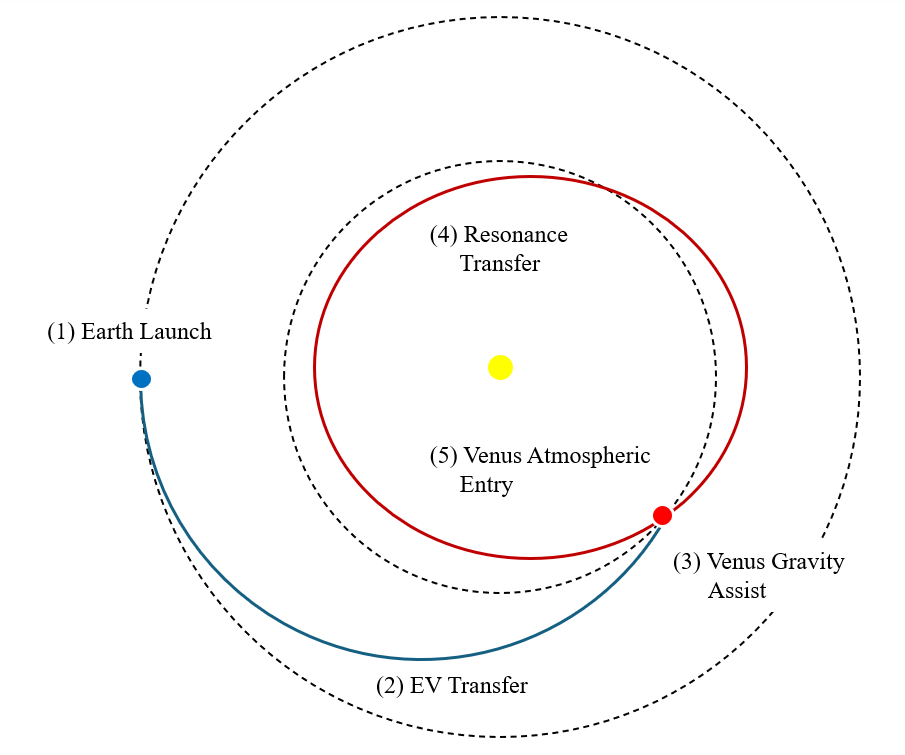
The resonant-transfer concept adds one Venus flyby before entry. The spacecraft first encounters Venus, uses the flyby to enter a resonant heliocentric orbit, and then returns to Venus for atmospheric entry with a new arrival geometry.
Concept
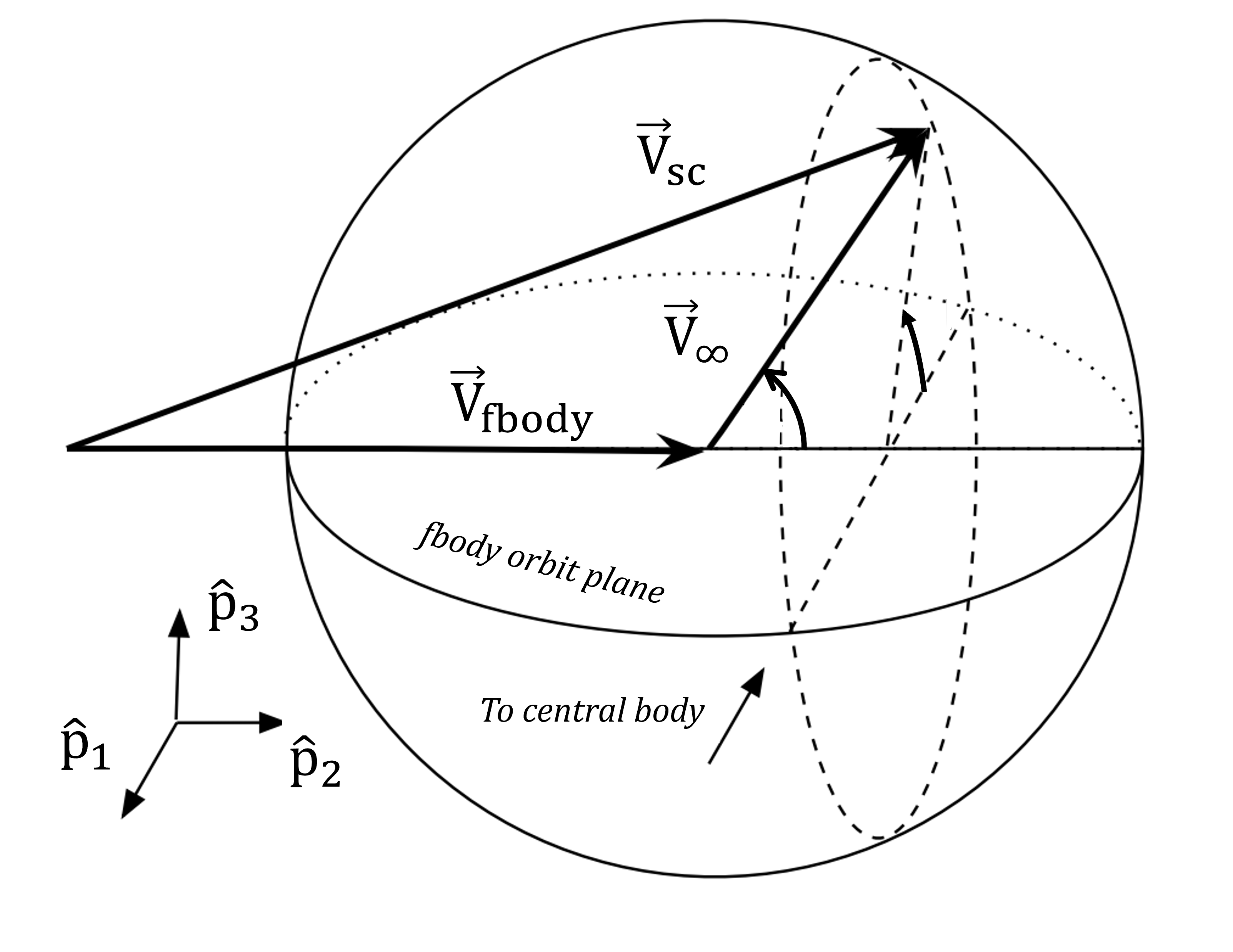
Flyby Geometry
The architecture replaces immediate direct entry with an intermediate Venus flyby:
- Earth launch.
- Earth-to-Venus heliocentric transfer.
- Venus gravity assist.
- 1:1 resonant heliocentric transfer.
- Direct Venus atmospheric entry.
Accessibility Comparison
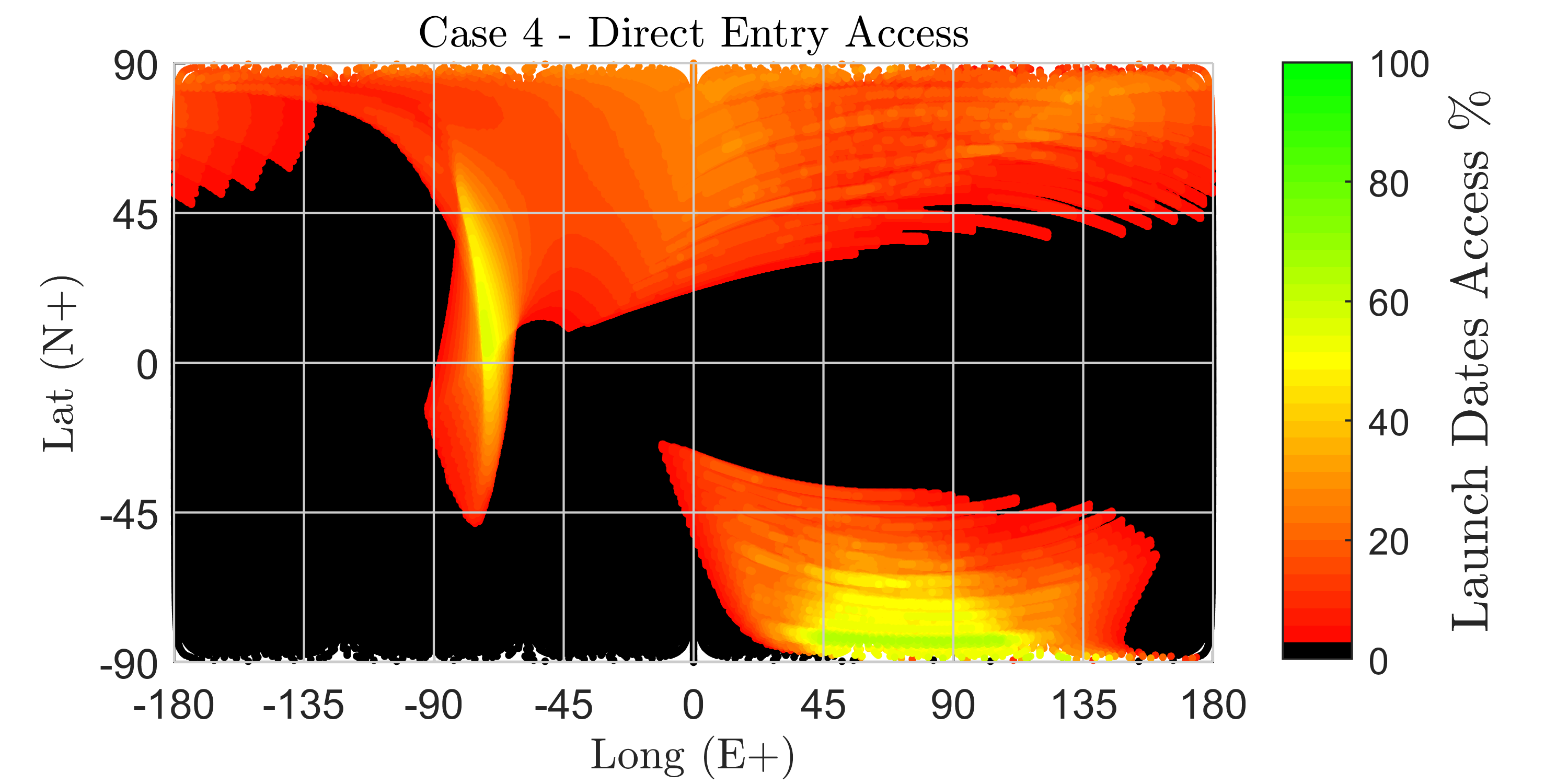
Direct-entry accessibility for the most constrained case studied.
Resonant-transfer accessibility for the same constraint case.
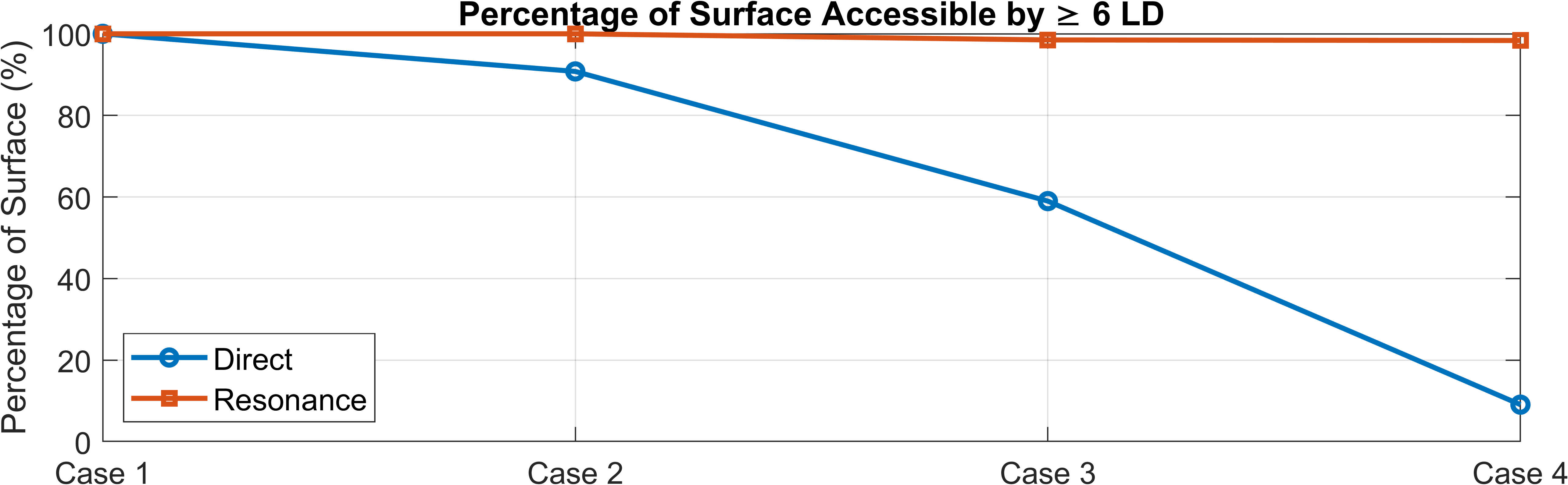
The direct-entry case is strongly shaped by the Earth-to-Venus arrival geometry. The resonant-transfer case uses the flyby and later return to increase accessible entry locations while still avoiding propulsive orbit insertion before entry.
Technical Highlights
- Entry access is evaluated in a Venus body-fixed frame.
- Constraints include entry corridor limits, peak deceleration, peak heat rate, illumination, and Earth line-of-sight.
- Earth-to-Venus trajectories are grouped by launch date and compared across direct-entry and resonant-transfer cases.
- The resonant-transfer cases retain broad surface access under constraints that substantially reduce direct-entry access.
- The main trade is additional time of flight and a second Venus encounter.
Related Output
Maxwell Jacobson and Ye Lu, “Expanding Venus Entry Accessibility through Resonant Transfer,” IEEE Aerospace Conference, 2026.